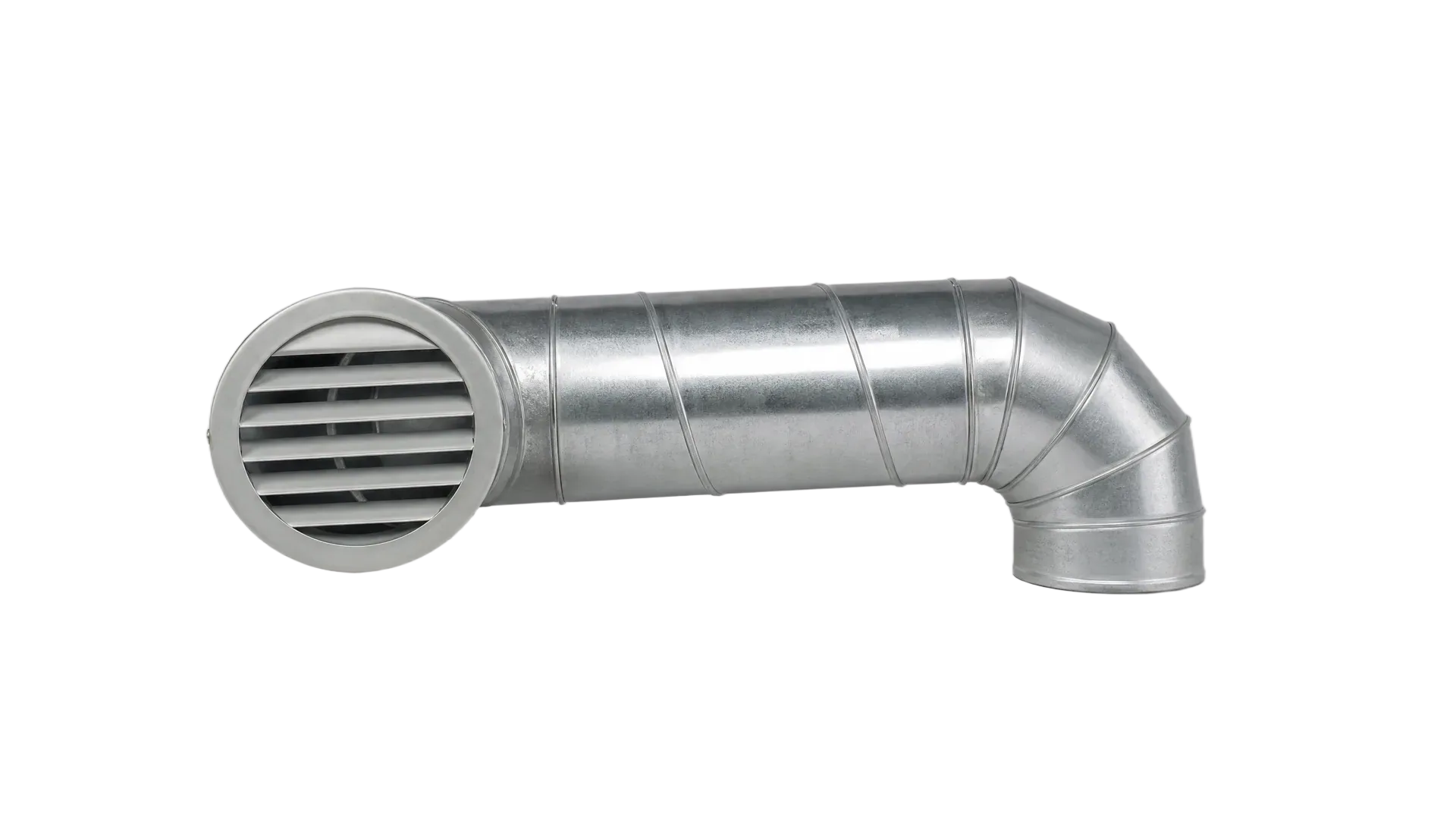
Clean ducts, dry basement
Bare metal duct and flex pipe like this has no film on it. No streaking, no dark spots around the seams, nothing sitting on top of the duct where dust can hold moisture. Air moving through it should carry no smell at all.
Your ducts have been running nonstop through another sticky North Carolina summer, and now you're catching a smell every time the air kicks on. Maybe there's a dark patch around a vent cover, or someone in the house has been sneezing more than usual indoors. You want to know what you're actually looking for, not just whether to worry.
A musty, damp smell when the air kicks on is usually the first thing people notice. Look at the vent covers themselves too. Mold shows up as black, green or gray speckling right at the edges, where moist air has been passing over cool metal. Humidity is what feeds it, and North Carolina summers push a lot of moisture through a duct system that's also running cold air all day. If the smell comes and goes with the AC, or someone in the house has started coughing or getting stuffy only indoors, that points at the ducts rather than something outside. A contractor can open the ducts and confirm what's actually growing there.

Bare metal duct and flex pipe like this has no film on it. No streaking, no dark spots around the seams, nothing sitting on top of the duct where dust can hold moisture. Air moving through it should carry no smell at all.

This is what months of dust and damp basement air leave behind. The dark coating on the duct surface is exactly where mold takes hold, especially once North Carolina humidity gets into a space like this. If your ducts look like this, a cleaning crew can tell you whether it's surface dust or something growing.
Walk past a vent and catch a musty smell that fades once you leave the room. Look at the vent cover itself and see dark specks around the edges that wipe off and come back. Someone in the house sneezes more indoors than outside, or the stuffiness never really clears even with the air running. You might see a damp ring where a duct joint sits, or dust that looks wet instead of dry. None of this shows up from one hot week. It builds over a summer of humid air moving through ducts that stay damp longer than they should, and left alone it keeps feeding whatever is already growing in there.

This is what a duct system looks like when it's dry. Bare metal plenum, flex and rigid runs crossing the joists, no staining anywhere along the seams. The vent pipes and wiring nearby are just sharing the space, not feeding moisture into it. Air moving through stays clean because nothing in that basement is giving the ducts a reason to sweat.

Here the ductwork sits low against the joists with wiring crossing right underneath it. Any damp spot on the subfloor above or condensation dripping off a duct seam lands close to wood and insulation. Once a duct runs through a tight, humid space like this, a small leak or a sweating seam has nowhere to dry out.




A musty smell that keeps coming back isn't something to watch for another month. Mold in a duct doesn't dry out on its own, and a North Carolina summer gives it exactly what it needs to keep going: warm air, moisture, and a system that runs for hours every day pushing air past it. Once it's established in the metal or the lining, it keeps shedding spores into every room the duct feeds, and it won't matter how many times you wipe down a vent cover if the source is further back in the run. Someone who works on duct systems in this area knows where that moisture tends to collect and what it looks like once it's gotten past the surface. A local contractor who takes this on can get into the duct itself and find what's actually there, instead of you guessing from a smell near a vent. That's worth sorting out before another summer does the same thing to the next six months of air moving through your house.
Mold doesn't settle into a duct just because the air is humid. It needs a wet surface to sit on, and that usually traces back to a condensate line that's been draining where it shouldn't, or a coil that's been sweating onto the duct above it. Once that surface stays damp for a few days running, any dust already sitting there gives mold something to take hold in. That's why a clean, dry duct with plenty of dust can go years without a problem, while a duct with a slow drip issue turns in a matter of weeks.
Where the duct runs matters as much as what it's made of. Flex duct holds moisture inside its insulation longer than sheet metal does, so the first signs usually show up at the seams and joints, not along a flat run. And a duct that passes through a crawl space or attic in North Carolina stays wet longer than one running through conditioned space, since the air around it is working against it instead of helping it dry.
Inside the duct, mold grows toward the airflow, not away from it. The surface facing the air stream usually shows more growth than the back wall, because that's where the moisture and the dust both collect. A system that short cycles, kicking on and off in short bursts, makes this worse. It never gives condensation enough time between cycles to dry out before the next round of moist air comes through.
At 14 cents a kilowatt-hour, running the blower longer than it needs to run costs you real money. Mold-fouled ducts push conditioned air through a dirtier, damper path, so the system works harder to cool the same rooms, and that shows up on the bill before anyone finds the source.
EIA-861 2025 statewide residential average




A musty smell near a vent, dark specks that wipe off and come back, a cough that eases once you're outside: any one of those points to moisture sitting somewhere in your ducts. It won't clear on its own, and in a North Carolina summer the system only feeds it. What you need isn't a crew of strangers quoting over the phone. It's one licensed contractor local to you, someone who works on duct systems all season and has seen what a coil or condensate line does when it's been dripping for weeks, looking at your actual runs and telling you what's really in them. You get matched with that one contractor, not a handful competing for your callback. From there, what shows up at the vent cover tells you whether it's dust or something that's been growing. Either way, you'll know where you stand instead of guessing every time the air kicks on.

Your request stays with one local pro.