Sealed and running right
The metal joints here are tight, so the air moving through reaches the rooms it was sent to. The system cycles on, satisfies the thermostat, and shuts off. No warm pockets upstairs, no room that never quite cools in August.
You catch a problem early, before it turns into something bigger, so you notice when rooms don't feel right or the system seems to be working harder than it should. Leaky ducts show up in ways that are easy to brush off as nothing, a warm room here, a dusty vent there, but they add up to real air going where it shouldn't. Knowing what to look for tells you whether what you're seeing is actually your ductwork.
A room that stays warmer or colder than the rest of the house, especially one far from the furnace or the air handler, usually means the duct feeding it is losing air along the way. Air escaping into the attic or under the house doesn't make it to the vent, so that room runs short all summer and all winter. A bill that's climbed without a change in how you use the system points the same direction, since the furnace or AC has to run longer to make up for what's leaking out. Dust around vents, or a musty smell when the system kicks on, means the ducts are pulling in air from the attic or crawlspace instead of just moving the air already in your home.

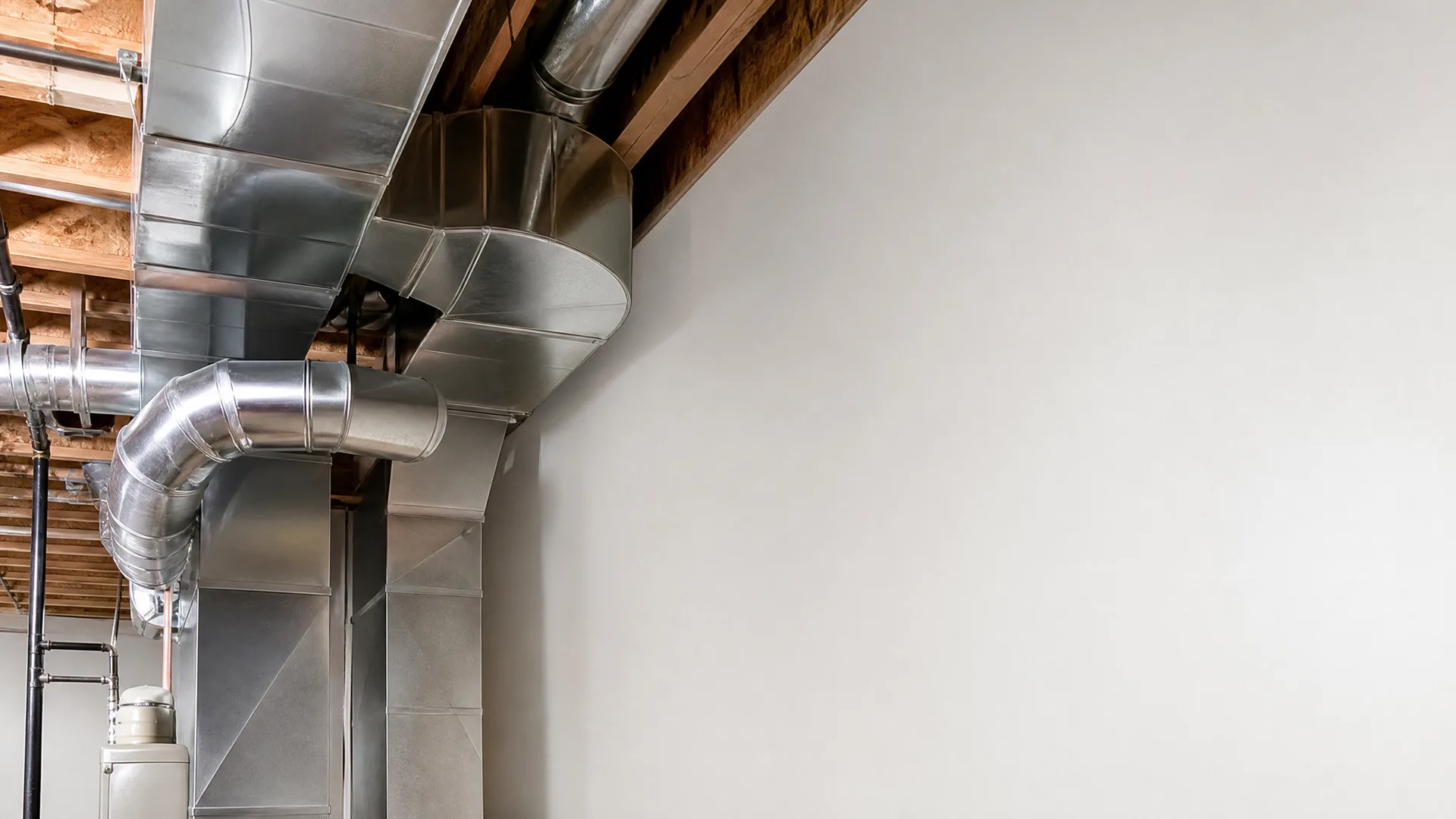
The metal joints here are tight, so the air moving through reaches the rooms it was sent to. The system cycles on, satisfies the thermostat, and shuts off. No warm pockets upstairs, no room that never quite cools in August.

Where sections meet, a gap or loose seam lets conditioned air spill into the basement instead of your living space. The blower runs longer to make up for it, and the rooms farthest from this junction are the first to feel it.
Half the homes here were built by 1997
Half the homes in Mecklenburg County were built in 1997 or earlier. Ductwork that old has had decades to work joints loose or wear through flex runs.
Heat runs October through April
Heat runs here from October through April, about seven months. A leak dumps conditioned air into the attic or crawlspace for most of the year.
Cooling runs May through September
Cooling runs May through September. Five months of humid air moving through a leaky duct is five months of moisture finding its way where it shouldn't.
ACS 2020-2024 · NOAA nClimDiv 1991-2020

These joints are wrapped tight and the runs sit clean across the joists. Air moves from the furnace to every register without losing pressure along the way. A basement like this holds its insulation value too, since conditioned air isn't leaking into the floor joists before it reaches the living space above.

Seams like these open up over time, and once they do, air meant for your bedrooms ends up in the basement instead. You'll feel it as a room that won't cool down or a furnace that runs longer than it should. The PEX lines nearby aren't the issue. The sheet metal above them is.


Most ducts here run through the attic or a crawl space, places that sit outside the conditioned part of the house. A joint that opens up in one of those spots doesn't just lose air into the room below it. It dumps that air into attic space that can run well past 100 degrees in July or into a crawl space that stays damp most of the year. The system has to make up for all of it, which means longer run times and a harder pull on whatever is powering it.
A duct system that's sealed tight loses only a small share of the air moving through it before that air reaches the registers. Once joints work loose or a flex run splits, that share climbs, and it climbs for good reason: the path from the furnace to the room is no longer sealed metal or intact flex, it's metal and open seam. Everything the system produces still has to pay for conditioning that air. The register still blows, but less of what left the furnace ever makes it to the room.


Air leaves the furnace or air handler under pressure
That air pushes through ducts toward every register
A gap at a joint or seam lets pressurized air escape
Lost air pressurizes the attic or crawl space instead


At 13.33 cents per kilowatt-hour, every bit of air leaking out of your ducts before it reaches a register is electricity you paid for and didn't get. With a furnace or heat pump running on electric power most of the year here, a leaky duct run keeps costing you long after the air has gone.
EIA-861 2025

The sun's been up for an hour and the living room is warm with it. You're on the couch with coffee, and you notice the light is hitting the ceiling vent just right, enough to show the dust gathered on the grille, a soft gray line following the slats. There's more of it on the side table underneath, and on the lamp shade next to it. You wipe the table with your sleeve and it's back within the week. A local contractor who services ductwork all over Mecklenburg County could tell you in minutes whether that's just a dirty filter or a gap somewhere pulling in attic dust with every cycle.
A duct system that's losing air isn't something you fix by feel. You can hear a hiss near a joint, or notice one room running warmer than the rest, but the leak itself is usually in the attic or under the house, in a run you can't see or reach. Someone who works on ductwork in Mecklenburg County every season knows where these systems tend to give out first, whether that's a crushed flex run, a seam that was never sealed right, or a boot pulled loose from a register. That's the kind of thing a camera and a pressure test catch fast, and a walkthrough that starts in the right place saves you from paying to heat or cool your attic all winter and summer. Submitting your information here puts your situation in front of one licensed local contractor, not a handful of companies competing for your callback. They'll look at what you described, including the rooms that never feel right, and reach out to figure out what's actually going on with your ducts.

You feel it room by room. The nursery stays cold in January no matter what the thermostat says. The bonus room over the garage turns into an oven by July. You keep closing vents, moving a fan in, telling yourself it's just that one room. It's usually the duct run feeding it, losing air before it ever gets there.
The furnace or heat pump doesn't know any of this. It just keeps running to satisfy a thermostat that's reading one room while three others sit wrong. That's wear on equipment that would otherwise cycle normally, and it's dust pulled in through the same gaps and pushed back out of your registers. A local contractor who deals with duct systems around Charlotte every season can walk your attic or crawl space and find exactly which run is costing you, instead of you guessing room by room.

A new furnace or heat pump run through old leaky ductwork still loses air at every bad joint. The equipment can be rated high, but if a quarter of the air it pushes never reaches a register, you're paying for capacity you don't get. Homeowners who replace the unit and skip the ducts often find the bill barely moves, and the room over the garage still runs hot in July. The ducts carry the air. If they're not sealed, new equipment just makes stronger air to lose.

Sealing the duct joints first changes what the rest of the system has to do. A furnace or heat pump sized for your house was sized assuming the air it makes gets where it's going. Once the runs hold pressure, every register puts out what it's supposed to, the thermostat reads the room instead of a mix of conditioned and attic air, and the system doesn't have to work past what it was built for just to cover a leak upstream.
A leaky duct system usually tells on itself before you ever see the duct. A room that won't hold its temperature, a utility bill that climbs without a reason, a furnace or heat pump that runs longer than it used to, dust settling on the grille faster than it should. Any one of those on its own might mean something else. A few of them together, in a house that still has the ductwork it was built with, point straight at a joint or seam that's come loose somewhere in the attic or under the floor. You don't need to see the leak to know it's there. You just need to notice what the house has been telling you, and take it seriously instead of working around it room by room. The ductwork is the part of the system you never look at, which is exactly why it's worth checking when something feels off.




Find a duct system cleaning pro in Mecklenburg County
A licensed pro who works in Mecklenburg County gets your request.