How often to clean air ducts in North Carolina

A local pro who cleans ducts gets in touch with you.

Get matched

How often should I get my air ducts cleaned in North Carolina?

You keep an eye on small things before they turn into bigger ones, so you're probably not asking because something's gone wrong. You just want a number to go by for your ductwork, something that fits how homes run here with humid summers and electric heat, so you can put it on the calendar and stop thinking about it.

Every 3 to 5 years

Most homes in North Carolina do fine with duct cleaning every 3 to 5 years. The humidity here is the reason the lower end of that range matters. Sticky summers push moisture into the system, and ducts that stay damp for long stretches can grow mold or collect more dust than they would in a drier climate. If your home heats with electric resistance or a heat pump, the air handler runs often through both summer and winter, moving that dust through the ducts more than a gas system might. If anyone in the house has allergies, or you can see dust coming out of the vents, lean toward the 3-year mark instead of 5.

  1. A technician inspects the ducts with a camera to check buildup.

  2. Every supply and return vent gets sealed off but one.

  3. A vacuum attached to the ductwork pulls air to negative pressure.

  4. Agitation tools knock dust loose as the vacuum collects it.

Wondering if the dust in your house is coming from the vents

You might notice it when the system kicks on: a musty smell for the first minute or two, or a layer of dust on furniture that comes back days after you wipe it down. Some homes show dark smudging around the vent covers themselves. None of that confirms the ducts are the source, but it's worth checking before you assume it's just North Carolina humidity. If anyone in the house has allergies or asthma, buildup in the ducts can make the air harder to live with, especially once summer humidity settles in and anything damp in there has a chance to grow. It's not usually urgent, but it's not nothing either.

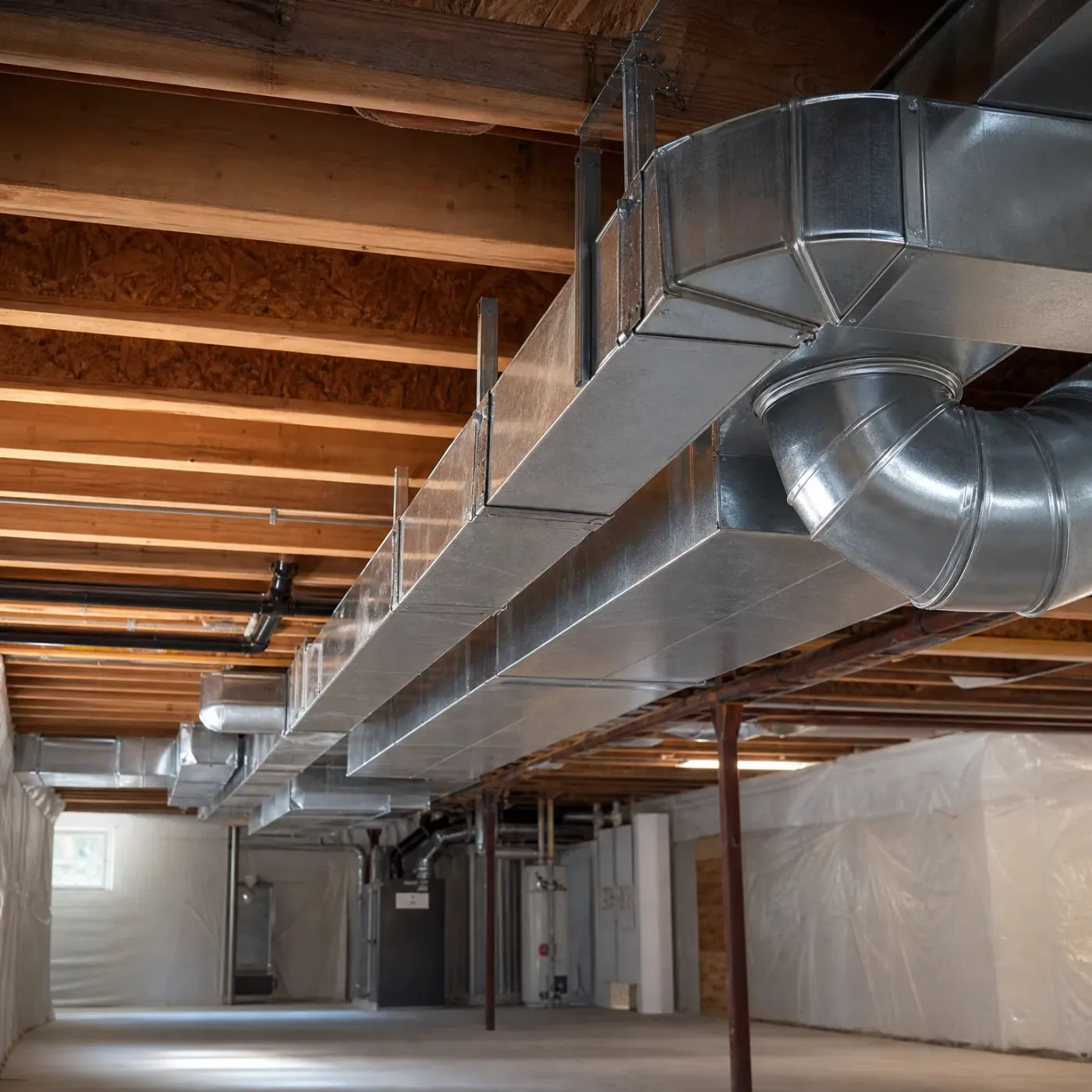
Unfinished basement with bare concrete walls and floor, showing exposed wood floor joists overhead with sheet-metal rectangular ductwork, insulated flexible ducts, and pipes.

Ducts doing their job

This is what a duct system looks like when it's keeping pace with your home. The metal trunks and flex runs sit clean and dry, moving conditioned air through the joists without resistance. No buildup lining the walls of the duct, no musty pull of air when the system starts.

Basement ceiling with galvanized sheet metal rectangular ducts and round pipes running between wooden joists above a bare concrete wall and floor.

Ducts that need a look

Same kind of basement, same layout of trunk and flex duct overhead, but buildup has had time to settle along the interior walls. Air still moves through, but it's carrying more with it than it should. This is the point where cleaning stops being optional and starts being overdue.

A woman in a cream cowl-neck sweater sits by a window with snow outside, in a dimly lit living room with a sofa, lit lamp, mirror, candles and a fireplace.
A woman in a gray turtleneck sweater sits beside a large window looking out at snow-covered evergreen trees, in a dimly lit living room with a lit fireplace, lamps, couch and houseplant.
A woman in a cream turtleneck sweater stands beside a large window with snow-covered ground and bare trees outside, in a dimly lit living room with lamps, a sofa and framed art.
A woman in a grey cowl-neck sweater stands indoors near a window, looking out at falling snow, with a lamp, framed picture and couch in the warmly lit room behind her.
Unfinished basement with galvanized sheet-metal trunk ductwork and round branch ducts suspended beneath wood floor joists, with support posts, plastic sheeting on the walls, and a furnace and water heater along the far wall.

Get the right pro for your ductwork

Answer a few questions instead of calling shop after shop.

Your duct cleaning request goes to a local pro who does this work.

Fill out one form

No charge to send it. You decide if you hire them.

Doing it yourself or calling a contractor

Clean it yourself

  • You can wipe down the vent covers and registers you can reach with a vacuum hose and a damp cloth.
  • Changing the filter on schedule keeps new dust from building up between cleanings, but it does not touch what is already inside the ducts.
  • A shop vac at the register only reaches a foot or two into the duct, nowhere near the full run back to the trunk line.
  • Without sealing off the other vents and pulling the whole system to negative pressure, agitated dust just resettles further down the line.
  • You can spot dark smudging around a vent or a musty smell on startup, but you cannot see what is actually inside the metal.

Call a contractor

  • A contractor runs a camera through the ducts first, so the cleaning is based on what is actually built up, not a guess.
  • Sealing every vent but one and pulling the system to negative pressure is how the whole run gets cleaned, not just what is reachable by hand.
  • Agitation tools reach into the flex runs and trunk lines a shop vac never gets to.
  • Instead of calling around and explaining your duct setup to several companies, you get matched with one that already knows the work.
  • Comparing quotes and vetting licenses falls on the contractor's intake, not on you.
A bearded man in a plaid flannel shirt stands indoors beside a wood-framed, frost-covered window, looking outside, with a steaming brown mug on the sill and a wooden cabinet behind him.
A bearded man in a dark blue T-shirt sits on a gray couch, smiling and looking down to his left, with a bookshelf and a bright window behind him.

Power costs 14.00 cents per kilowatt-hour statewide

At 14 cents a kilowatt-hour, running a system harder than it needs to doesn't cost much to notice, but it adds up over a full year of heating with electricity. Dust-clogged ducts make the blower work longer to push the same air through your house, and that shows up on the bill before it shows up anywhere else.

EIA-861 2025 statewide residential average

Empty concrete-walled basement room with galvanized rectangular and round HVAC ducts and pipes running along the exposed wood-joist ceiling.
Before you get your ductwork cleaning
Unfinished basement with galvanized sheet-metal ductwork and pipes beneath wood joists, a gray furnace unit at left, insulated plastic-covered walls over a concrete foundation, and a bare concrete floor.
After you get your ductwork cleaning

Every 3 to 5 years

That's the general rule for duct cleaning in a home without pets, allergies, or a recent renovation. Mark your calendar so it doesn't slip your mind.

Skip the search

One camera inspection

A technician can run a scope through your ducts and show you the buildup directly, so you're not guessing at whether it's time yet.

Skip the search

Every 3 to 5 years is the number to hold onto, sooner if you've had a renovation, pets, or someone in the house with allergies acting up more than usual. North Carolina's muggy summers push humidity through that ductwork for months at a time, and that's exactly the kind of environment that turns ordinary dust into something worse. A camera inspection settles the question either way, so you're not guessing at what's inside walls and joists you can't see. Once you know where you stand, the harder part isn't the cleaning itself, it's finding someone licensed to do it, checking they're worth the call, and getting a straight answer on scheduling without working through a list of names on your own. That part can be handed off. You'd otherwise be the one tracking down contractors, calling each one, explaining the same thing about your vents and your house again, then sorting through quotes that don't line up. None of that changes what the duct work costs or how long it takes. It just means you're not the one doing the legwork to get there.


A shingled two-story house with lit windows and stone accents at dusk, with a stone paver walkway and landscape lighting leading past ornamental grasses toward a calm bay under an orange and blue sky.

Ductwork Cleaning

Get your ductwork to the right pro

Duct and vent cleaningDucts or ventsNorth Carolina
Step 1 of 2

What ZIP code is the job in?

  • A gray upholstered sofa arm with a cream knit fringed throw sits beside a wooden side table holding a stack of books, a shallow wooden bowl, and a ceramic vase of leafy branches, on a wood floor near a window.
    • Say what's going on with your ductwork, and a pro who works on them reaches out.
  • A living room corner with a cream upholstered sofa and cushion beside a wooden side table holding a ceramic vase of olive branches and a small dark bowl, with a framed landscape painting on the gray wall and a linen curtain at the window.
    • Once you send the form, finding a pro is off your list.
    • After you send the request, you're done searching.
  • A wood-framed armchair with a beige cushion and knitted throw sits beside a round wooden side table holding a ceramic mug, with a potted green plant near a window in the corner and a framed picture on the wall.
    • Explain the job once and skip repeating it on every call.
    • Skip searching for a duct system pro and answer a few questions instead.
  • Interior corner with beadboard wainscoting, a gray cabinet with wood countertop holding a vase of greenery below a window, and a potted leafy plant in a woven basket on a wood floor with a fringed jute rug.
    • Your duct cleaning request goes to one local pro.
    • Your request goes to one pro, not a list of companies.