A local pro who services air conditioners gets in touch about the tune-up.
Closing a vent or two feels like it should help. Less air going into a room you don't use, more pressure pushing cold air where you need it. It doesn't work that way. Your system is built to move a set amount of air. Shut vents and that air has nowhere to go but back through the ducts, and the pressure can push the unit harder than it was designed to run.
In a North Carolina summer, that matters more than most places. The system is already working long hours against the heat and the humidity. Add strain from closed vents and you're asking more of a coil and a blower that are already earning their keep. That can mean a bigger power bill, since most homes here run on electric heat and cooling, and power costs the same whether the system runs efficiently or not.
A yearly maintenance visit is where a contractor actually checks this kind of thing, the airflow, the pressure, whether the ductwork is doing its job. That's different from guessing at vents on your own and hoping it helps.
Finding someone to do that checkup is its own chore. Searching for a contractor, calling a few, explaining what's going on in the house more than once, waiting on quotes that are hard to compare because nobody measured the same things. You don't have to do that part. Answer a few questions about your home and your system, and a contractor who handles maintenance in your area will be matched to your situation and reach out to you directly. No searching, no repeating yourself, no sorting through quotes that don't line up.
What happens at the visit, what gets found, what it takes to fix, that's between you and the contractor. What this page can do is skip the part where you spend an afternoon trying to find the right person to call.
Closing vents doesn't help your AC, and in most homes it works against it. The system moves a fixed amount of air no matter how many vents are open. Close a few and that air backs up in the ductwork instead of reaching the rooms you still use. Pressure builds, airflow across the indoor coil drops, and the coil can ice over. Once that happens the system cools worse, not better, in the rooms you actually want cold. On a sticky North Carolina afternoon that's the opposite of what you need. The better fix is leaving vents open and letting the system run as it was set up to run, then having it checked if some rooms still run warmer than others. That's usually a sign of a duct or airflow problem worth looking at, not something a closed vent will fix.
Where That Air Actually Goes
The blower pulls a set amount of air whether every vent is open or three are shut.
Closed vents push that air backward into the supply duct, raising pressure past what the system was built for.
That pressure finds the weak spots in the ductwork, usually the seams and the joints, and pushes air out there instead.
Air leaking into a crawlspace or attic is air you paid to cool that never reaches a room.
The evaporator coil needs steady airflow across it, and choked airflow lets it run colder than it should.
A coil that drops below freezing builds ice, and ice stops the system from cooling at all.
The blower runs at a fixed speed built around the whole duct system, not the two or three rooms you're trying to cool. When you shut vents, you haven't lowered that output. You've just taken away the places that air was meant to go. It has to go somewhere, so it pushes back into the supply ducts, and pressure there climbs past what the joints and seams were sealed for. Ductwork isn't airtight to begin with. Most runs have seams, taped joints, places where a branch line connects to the trunk. Under normal pressure those spots hold. Under the extra pressure from closed vents, they leak, and the air that escapes into a crawlspace or attic is gone. It never reaches the room you're trying to cool, and the system has no way of knowing that. It just keeps running, trying to satisfy a thermostat that isn't getting the air it should. Meanwhile the coil inside the air handler depends on a certain volume of air moving across it to stay at the right temperature. Restrict that airflow and the coil runs colder than it's designed to. Past a point, moisture on the coil freezes instead of draining off. Once ice forms, airflow drops further, more of the coil freezes, and the system can go from cooling fine to not cooling at all within the same afternoon.
Vents open, air moving through every room the way the system was built to run.
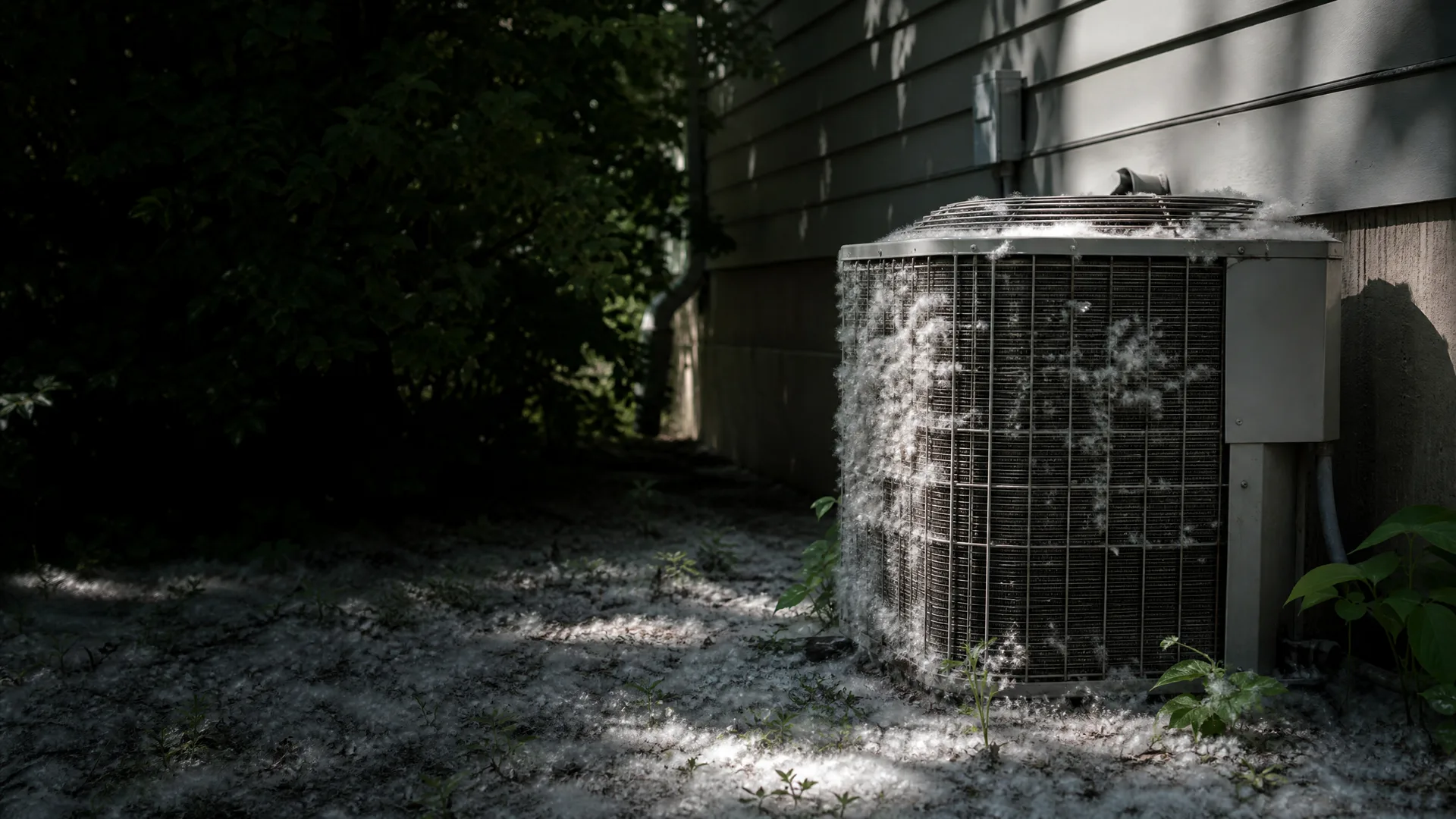
Leaves piling up against a dirty condenser, the kind of strain closed vents add to over time.
You walk around the side of the house to check on the unit and find the condenser coated in cottonwood fluff, caught in every fin. It's late spring, that week or two when the trees let go all at once, and the white drifts have settled against the coil like snow that won't melt. You'd closed off the guest room vent back in March thinking it would ease the load. The fan runs, but it sounds like it's working harder for less air. Between the blocked airflow outside and the backed-up pressure from that closed vent inside, the system is fighting itself from both ends. A technician who services it regularly would catch this kind of buildup before it costs you a coil.
A closed vent or two won't ruin anything by itself, but North Carolina summers run the system hard enough that the extra strain adds up over a season. Pressure that builds month after month from closed vents shows up as a coil that freezes, a blower that works harder than it should, or a duct joint that finally gives out at the seam. Catching that early is what maintenance is for, and a technician who checks static pressure and airflow at each vent can tell you whether your setup is actually hurting the system or just feels like it should. Working that out on your own means finding someone local, explaining the house and the vents you've been closing, and doing it again with the next company if the first quote feels off. Handing it off means one contractor familiar with systems like yours gets in touch and looks at what's actually happening in your ductwork, instead of you guessing room by room all summer.
What the duct tape test shows
Flex duct runs through the attic or crawlspace, and most of it isn't sealed as tight as it should be. When pressure in the system rises, air finds those loose joints before it finds the room you shut the vent on. It leaks into the attic instead of the house. A tech checking ductwork for leaks is checking for exactly this. The air your system is paying to cool never makes it past the duct, so the room gets nothing and the attic gets a little cooler for no reason at all.
Why one open vent isn't the fix
Some rooms need a closed door and an open vent to stay comfortable, a bedroom over a garage or a sunroom with west-facing windows. That's different from shutting vents to save on the bill. A system sized for the whole house still moves the same air whether four vents are open or twelve. Closing most of them doesn't lower what the blower pushes out, it just gives that air fewer places to go, and the rooms still open end up fighting the pressure from the ones that are shut.
Power costs 14.00 cents per kilowatt-hour statewide
At 14 cents a kilowatt-hour, you're not paying a steep rate for power here, but your AC still runs most of the day through a Carolina summer. Closing vents doesn't lower that bill. It just makes the system work harder for the same amount of cooling.
EIA-861 2025 statewide residential average
Before you get your air conditioner maintenanceAfter you get your air conditioner maintenance
That muggy feel to North Carolina summers has a number attached to it. The dew point averages 67°F across June, July and August, according to NOAA climate data, and anything above 65°F reads as sticky to most people. Your AC isn't just lowering the temperature on the thermostat. It's pulling moisture out of the air, and at a dew point like that, it has to pull a lot. Close vents and add pressure to a system already working to wring water out of thick air, and you've given it two jobs to fight instead of one. The house ends up cool but clammy, with the air conditioner running long stretches just to get there.
NASA POWER T2MDEW county cells weighted by homes
Why does one room still feel warm with the vent shut
You closed the vent in the guest room to push more cold air to the rest of the house, and the room you're actually sitting in still isn't cooling down the way it used to. You might hear a hiss near the ductwork in the attic or crawlspace, or notice the system running longer to hit the same temperature on the thermostat. Some rooms run cold while others lag behind no matter how long the system runs. Over a full Carolina summer, that extra pressure is what pushes a struggling system toward a frozen coil or a blower that gives out early, and that's a repair instead of the tune-up that would have caught it.
Vents open, system running as built
This is what a system under normal load looks like. The condenser outside runs steady, the lines stay clear, and every room gets the air it was designed to get. Nothing is fighting the ductwork.
The strain shows up outside, not just in the vents
A unit like this has been running against pressure it wasn't built for. The weathering you see on it is what years of a hard-working system look like. Closed vents inside add to that load every summer the system runs.
Leave the vents open and let the system do what it was built for
Closing vents doesn't help your AC. Open them back up and let the air move the way the system was designed to move it. That's the whole answer. Everything else is what happens to a system that keeps running against pressure it wasn't built to handle, summer after summer, in a state where the AC runs most of the day for months at a time.
If a room still runs warm or the system seems to be working harder than it should, that's worth having someone look at before next summer, not something to chase with the vents. A contractor who knows North Carolina ductwork and how it holds up under a Carolina summer can look at your system, tell you what's actually going on, and reach out to you directly. No explaining the problem three times to three different companies, no sorting through quotes on your own. Just someone who already knows what they're looking at.
Air Conditioner Maintenance
Matched to your air conditioner job
Skip searching for an air conditioner pro and answer a few questions instead.